
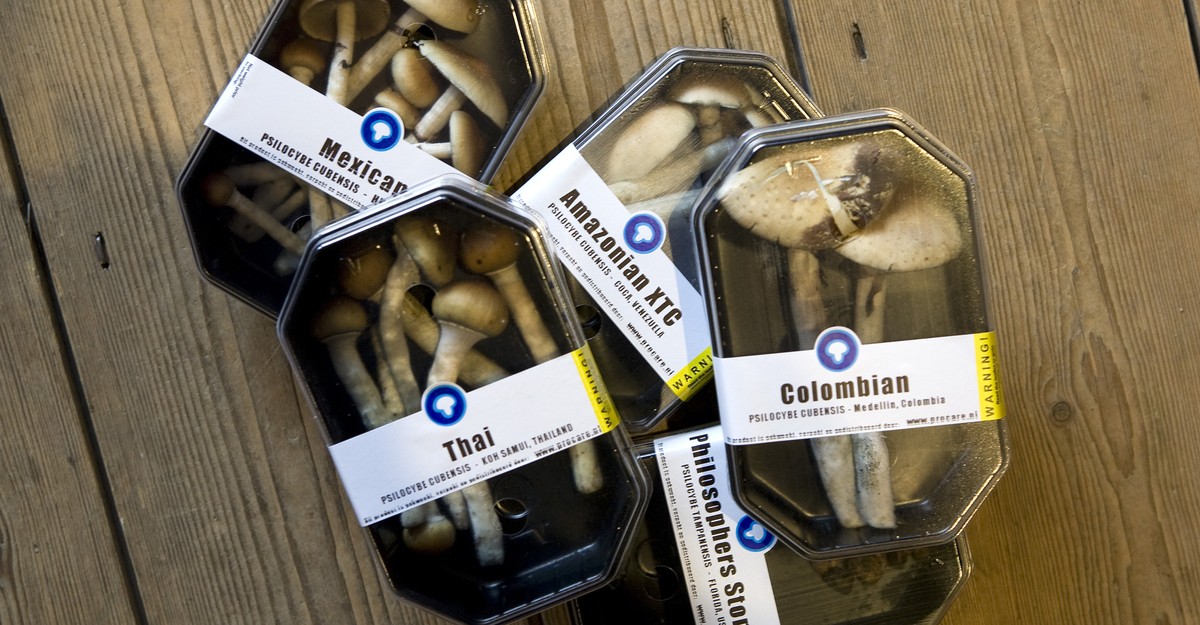
The term “mushroom” in a psychoactive context usually refers to fungi containing the naturally occurring compounds psilocybin and psilocin. The mushrooms themselves are biological organisms; the primary psychoactive chemicals are psilocybin and its active metabolite, psilocin.
Psilocybin
- Chemical name (IUPAC):
[3-(2-dimethylaminoethyl)-1H-indol-4-yl] dihydrogen phosphate - Molecular formula:
C₁₂H₁₇N₂O₄P - Molar mass:
284.25 g/mol
Chemical class
- Tryptamine derivative
- Indole alkaloid
- Naturally occurring psychedelic compound
Key structural features
- Indole ring system (similar to serotonin)
- Dimethylaminoethyl side chain
- Phosphate ester group attached to the aromatic ring
Functional groups
- Indole heterocycle
- Tertiary amine
- Phosphate ester
Psilocin (active metabolite)
Psilocybin is converted in the body to psilocin, which is primarily responsible for the psychoactive effects.
- Chemical name (IUPAC):
3-[2-(dimethylamino)ethyl]-1H-indol-4-ol - Molecular formula:
C₁₂H₁₆N₂O - Molar mass:
204.27 g/mol
Chemical class
- Tryptamine
- Indole alkaloid
- Serotonergic psychedelic
Key structural features
- Indole ring
- Hydroxyl group (-OH) at the 4-position
- Dimethylaminoethyl side chain
Functional groups
- Phenolic hydroxyl group
- Tertiary amine
- Indole heterocycle
| grams | 18, 28, 40 |
|---|
Be the first to review “Mushroom ”
Related products
Uncategorized
Price range: $150.00 through $485.00
Uncategorized
Price range: $175.00 through $250.00
Uncategorized
Price range: $170.00 through $535.00
Uncategorized
Price range: $175.00 through $341.00
Uncategorized
Price range: $240.00 through $810.00
Uncategorized
Price range: $85.00 through $150.00
Uncategorized
Price range: $220.00 through $500.00
Reviews
There are no reviews yet.