

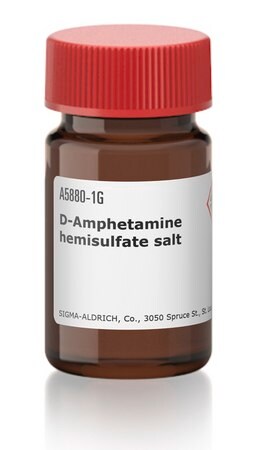

Amphetamine is a synthetic central nervous system stimulant belonging to the phenethylamine and amphetamine classes of compounds.
- IUPAC name:
(RS)-1-phenylpropan-2-amine
(also commonly written as α-methylphenethylamine) - Molecular formula:
C₉H₁₃N - Molar mass:
135.21 g/mol
Chemical class
- Phenethylamine
- Substituted amphetamine
- Monoamine stimulant
Key structural features
- A benzene (phenyl) ring
- A two-carbon ethyl side chain
- A primary amine group (–NH₂)
- An α-methyl group attached to the carbon adjacent to the amine
Functional groups
- Primary amine
- Aromatic phenyl ring
Stereochemistry
- Contains a single chiral center
- Exists as two enantiomers:
- Dextroamphetamine (d-amphetamine) — the dextrorotatory isomer
- Levoamphetamine (l-amphetamine) — the levorotatory isomer
- The two enantiomers have different pharmacological properties
Pharmacological chemical class
- Monoamine releasing agent
- Interacts primarily with:
- Dopamine transporter (DAT)
- Norepinephrine transporter (NET)
- To a lesser extent, the serotonin transporter (SERT)
Structural significance
Amphetamine is the parent compound of a large family of substituted amphetamines. Small modifications to its structure produce related compounds such as:
- Methamphetamine
- MDMA (3,4-methylenedioxymethamphetamine)
- MDA (3,4-methylenedioxyamphetamine)
The addition of the α-methyl group distinguishes amphetamine from phenethylamine and increases its metabolic stability.
Physical characteristics
- Pure amphetamine is a colorless liquid in its freebase form
- More commonly encountered as crystalline salts, such as:
- Amphetamine sulfate
- Amphetamine hydrochloride
- Amphetamine phosphate
| grams | 10, 20, 30, 40 |
|---|
Be the first to review “Amphetamine”
Related products

Uncategorized
Price range: $240.00 through $810.00

Uncategorized
Price range: $175.00 through $341.00
Uncategorized
Price range: $220.00 through $500.00
Uncategorized
Price range: $85.00 through $150.00
Uncategorized
Price range: $175.00 through $250.00
Uncategorized
Price range: $150.00 through $485.00

Uncategorized
Price range: $130.00 through $270.00
Reviews
There are no reviews yet.