

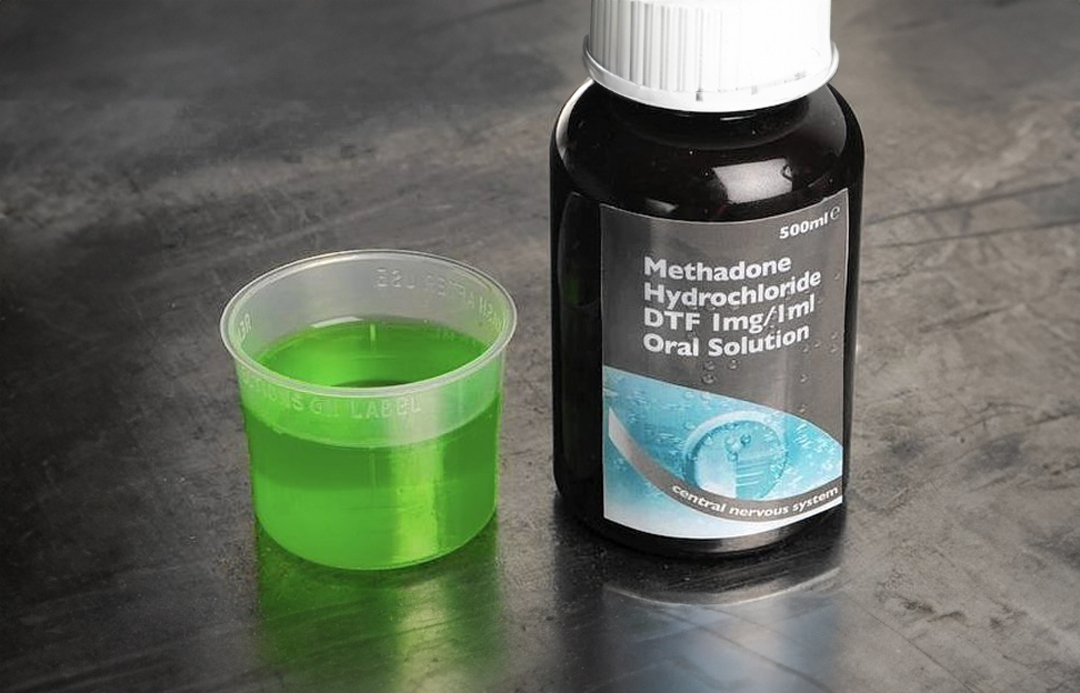


Methadone is a fully synthetic opioid belonging to the diphenylheptane class of compounds.
- Chemical name (IUPAC):
6-(dimethylamino)-4,4-diphenylheptan-3-one - Molecular formula:
C₂₁H₂₇NO - Molar mass:
309.45 g/mol
Chemical class
- Synthetic opioid
- Diphenylheptane derivative
- Tertiary amine-containing organic compound
Key structural features
- A seven-carbon (heptane) chain
- A ketone group (3-one) on the carbon backbone
- Two phenyl (benzene) rings attached to the same carbon (4,4-diphenyl)
- A dimethylamino group attached to the chain
Functional groups
- Ketone (C=O)
- Tertiary amine [N(CH₃)₂]
- Two aromatic phenyl rings
Stereochemistry
- Contains a single chiral center
- Exists as two enantiomers:
- (R)-methadone (levomethadone)
- (S)-methadone
- The R-enantiomer has most of the opioid receptor activity
Pharmacological chemical class
- μ-opioid receptor agonist
- Synthetic opioid analgesic
Structural significance
Unlike opioids such as morphine or oxycodone, methadone does not possess the classic morphinan/phenanthrene ring system. Instead, it belongs to the diphenylheptane family, characterized by:
- A flexible carbon chain
- Two phenyl rings
- A tertiary amine
This makes methadone structurally distinct from many naturally derived and semi-synthetic opioids.
Physical characteristics
- Pure methadone is typically a white crystalline solid
- Commonly encountered as methadone hydrochloride, a more water-soluble salt form
- Stable under normal storage conditions
| mg | 5, 10 |
|---|---|
| tables | 150 |
Be the first to review “METHADONE”
Related products
Uncategorized
Price range: $220.00 through $500.00

Uncategorized
Price range: $240.00 through $810.00

Uncategorized
Price range: $130.00 through $270.00
Uncategorized
Price range: $175.00 through $250.00
Uncategorized
Price range: $175.00 through $341.00
Uncategorized
Price range: $170.00 through $535.00
Uncategorized
Price range: $150.00 through $485.00
Reviews
There are no reviews yet.